Building a modern C2: when doctrine guides technique
The real issue of a C2 is not the screen. It's the time.
Command and control (C2) rooms are often judged by their display wall, the number of their stations, and the density of their screens. This is a misperception. A command center is not measured by what it displays, but by what it enables: to decide faster and better than the opponent. Everything else — ergonomics, workflows, security — is only valuable if it serves this singular objective.
This conviction structures Elecdan's approach. Before discussing equipment, we start with a question: how is a decision made in a C2, and where do the seconds that make the difference get lost?
The decision loop, the guiding thread of our work
The military doctrine has a proven framework for describing operational decision-making: the OODA loop— Observe, Orient, Decide, Act. This model, now taught in officer training and widely adopted as a framework for command and control, is based on a simple principle: against an adversary, agility prevails over brute force. The one who completes their decision cycle faster retains the initiative; the one who completes it more slowly suffers.
Observe
It is about converging sensors — video feeds, intelligence, position of forces — into a common operational picture.
Orient
The most demanding step is to transform this mass of raw data into understanding: cross-referencing, correlating, distinguishing the threat from the noise.
Decide
It is to choose a course of action under time constraints.
Act
It is to disseminate the order without distortion or delay — before the loop starts again, because the situation does not wait.
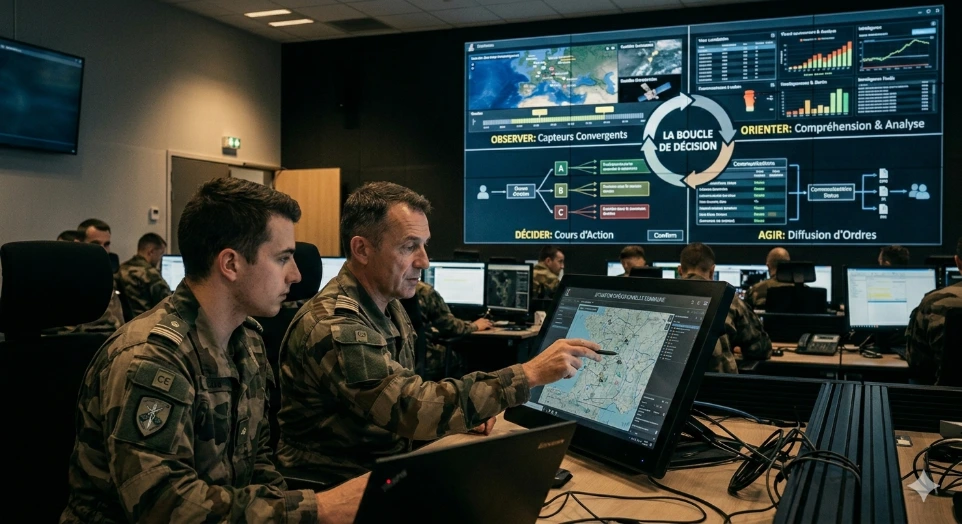
This doctrinal framework is not just a facade. It is our technical reading grid. Because each transition between these steps — between perceiving and understanding, between understanding and deciding — is a point where friction sets in and time is lost. It is precisely there, in these interstices, that the profession of Elecdan is played out. Our role is not to make the decision for the leader: the decision is the responsibility of command intent, rules of engagement, human judgment, which no machine can replace. Our role is to eliminate anything that slows down the loop or alters its reliability.
Three requirements, three responses
Accelerate the entire loop: latency as the enemy
Every millisecond of delay — in displaying a stream, in switching between two screens, in sending data to the video wall — adds friction between perception and understanding. When added together, these fractions of a second slow down the entire cycle.
We design and integrate video extension and distribution architectures aimed at the lowest possible latency: transport over fiber optics, aggregation of high-definition streams without dropouts, instant display at the operator's station as well as on the video wall. The operator experiences no wait between the moment the information exists and the moment they can utilize it.
For the most demanding performance needs, we particularly integrate KVM matrices IHSE, whose advantages directly serve the speed of the loop: imperceptible latency for the operator, transport of high-definition signals over long distances via fiber optics without destructive compression, and image fidelity suited for the densest streams — radar imaging, satellite mapping, combat systems. Where even the slightest degradation or delay can distort interpretation, this equipment ensures that what the operator sees corresponds exactly to the reality on the ground, at the moment it occurs.
Directing on all sources: the multi-domain station.
The orientation step involves crossing sources of different natures and levels of confidentiality: a classified mapping, an open news feed, a secure messaging system. In practice, an operator constantly juggles between several compartmentalized IT environments. If each switch costs them a few seconds — or worse, forces them to wonder which network they are on — orientation slows down and error looms.
Our switching solutions allow for an instantaneous source change between computers belonging to distinct classification domains, from a single workstation. The transition from one source to another is smooth — even down to the natural movement of the mouse from one screen to another — and the active domain is signaled without any possible ambiguity. The operator keeps all their sources in view, never losing track or tempo.
It is in this area that we integrate the secure switches HighSecLabs (HSL), designed specifically for multi-domain and multi-class use. Their advantages meet the orientation requirement point by point: guaranteed physical isolation between networks, allowing simultaneous access to environments of different classifications without any gateway between them; hardware filters preventing any leakage through keyboard and mouse devices; and immediate switching that imposes no waiting or complex manipulation on the operator. These devices are certified according to the Common Criteria (EAL4+ level) — a certification provided by the manufacturer, which attests to the level of isolation of the enclosures themselves and which we integrate into a certifiable overall architecture.
Protecting the integrity of decision-making: security by design
It is the most demanding pillar, and we refuse to present it as a constraint. A decision loop poisoned by false, compromised, or intercepted data does not slow down the decision: it produces a bad one, faster. Security is therefore not the enemy of speed — it is the condition for a just decision.
Allowing an operator to access both an open network and a classified network from the same workstation is the most sensitive scenario in the entire architecture. Mastering it flawlessly is at the heart of our expertise: physical separation between domains, controlled signal flow to prevent any leaks, protection against keystroke capture, neutralization of espionage vectors. This mastery allows us to uphold a promise that seems contradictory but is not: to be both fast and secure.
Our difference: designing and integrating
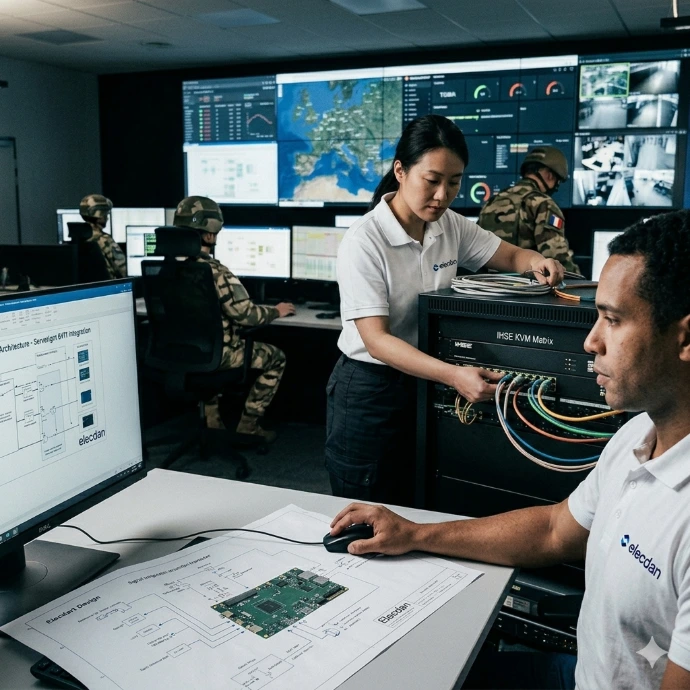
Many players know how to resell equipment. Others know how to design it. Elecdan does both — and that is what underpins our value.
We design our own solutions which gives us end-to-end control where it matters most: no black box, a logic of sovereignty, a capacity to meet specific requirements that the standard market does not cover.
And we integrate these building blocks, alongside the best available components — such as KVM matrices IHSE for performance or secure switches HighSecLabs for multi-domain partitioning — in a coherent and certifiable overall architecture. Choosing the right element for each need, ensuring that the whole functions as a unique system, and carrying this architecture through to certification by security authorities: this is what we bring beyond the sum of the equipment.
This dual position — designer and integrator — distinguishes us from both simple resellers and pure manufacturers. The client does not receive a list of materials: they receive a C2 that works, that holds up, and for which someone is accountable for the whole.
Accompany, not just equip
Building an effective C2 is not just about delivering a room. It is about understanding the client's mission, translating their doctrine into architecture, and supporting them from design to certification. That is why we always start from the decision — from the OODA loop — before talking about technique: because a command room has only one purpose, to give the leader the advantage of tempo.
This is Elecdan's commitment: to put our dual expertise as a designer and integrator at the service of a single promise —to decide faster, based on reliable information.