How to Improve the Ergonomics and Layout of a Military Command Center?
In a command center, the goal of the layout is to minimize the "friction of war": transforming a chaos of raw information into a clear and understandable tactical situation. Far from clichés, an operator's performance directly depends on managing their stress, the calm of the room, and ultra-optimized ergonomics.
The Central Element: The Video Wall
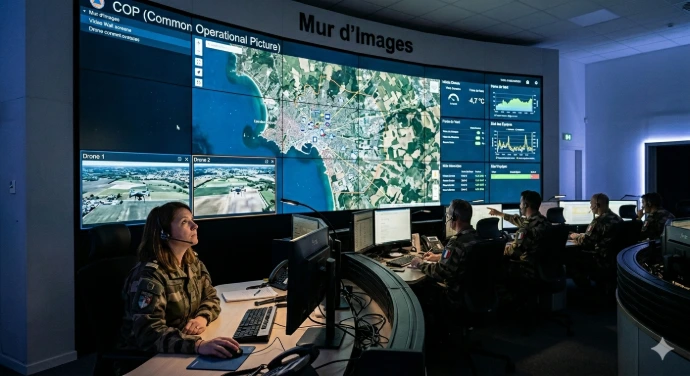
The "Video Wall" is the keystone of the layout. It must be sized to display the COP (Common Operational Picture) — combining satellite maps, drone video feeds, and live data — so that each operator can access it visually without moving.
- Our recommendation:For large permanent centers, the equivalent of 12 to 24 assembled 55-inch screens is essential to ensure perfect readability.
The Cognitive Ergonomics of the Operator Station (Multi-Screen)
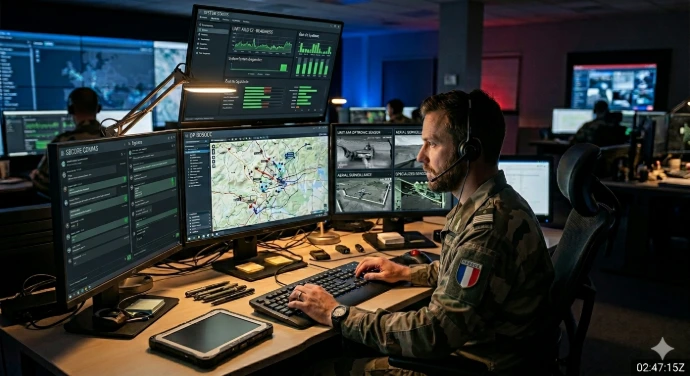
To accelerate decision-making speed and avoid time-consuming clicks during a crisis, the modern standard requires physical multi-windowing. An operator manages on average 3 to 4 dedicated monitors:
- Central Screen: Digital mapping or tactical combat system (e.g., SICS or SITAC).
- Side Screen 1: Secure communication flows and tactical chats.
- Side Screen 2: Live video feeds (drones, optronics) or news channels.
- Fourth Screen: System management (network statuses, sensors).
This processing through "instant visual scanning" allows for critical time savings where a 30-second wait can be dramatic.
Control of Atmosphere, Acoustics, and Human Factors
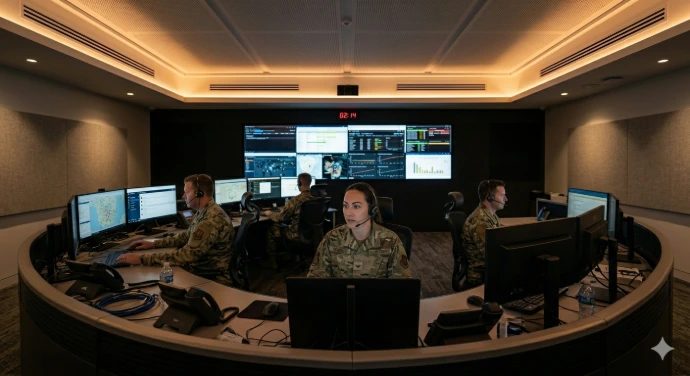
Unlike in cinema, a high-performing control room must be extremely quiet. Silence is golden to allow the Operations Director to formulate intelligible orders without raising their voice.
To optimize this environment:
- Acoustics & Audio: Communications should primarily occur via headsets and secure instant messaging to limit noise pollution.
- Circadian Dynamic Lighting: Operating rooms often functioning 24/7 and without windows, the installation of circadian lighting (which adjusts its color temperature throughout the hours) is essential to preserve the biological cycle of the operators and reduce visual fatigue.
- Thermal Comfort: Due to the accumulation of screens generating significant heat, air treatment systems must be sized to effectively cool the space while limiting fan noise.