Guide to Command and Control Centers and Military Operations:
Typologies and Arrangements
Military command and operations centers (commonly referred to as CO for Operations Center or C2 forCommand & Control) act as the "nerve center" of the armed forces. These ultra-optimized spaces centralize critical information flows to enable complex strategic decision-making in real time.
However, there is no one-size-fits-all. The number of operator positions and the technical architecture of a control room vary significantly depending on its mission (global planning, sector surveillance, or tactical combat).
The 4 Major Typologies of Command Centers
National Strategic Centers (Permanent)
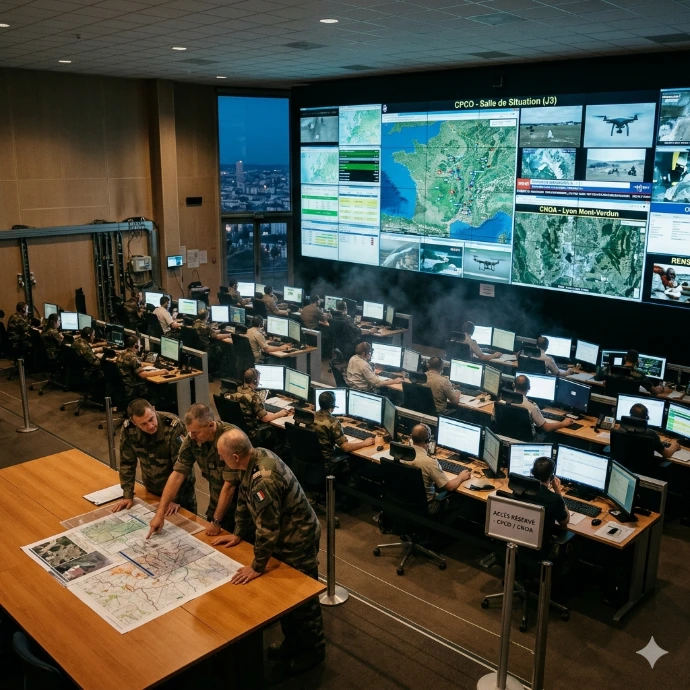
Use this snippet to create different types of components that show an image aligned to the left or to these "Bunker" or "General Directorate" type infrastructures represent the top of the decision-making pyramid. The goal here is strategic thinking and the centralization of global forces.
- Example of the CPCO (Paris - Balard):The Operations Planning and Conduct Center has a total staff of 200 to 250 people. Its "real-time" room (J3) has a dozen key positions, where each operator embodies a sectoral expertise (Special Forces, Intelligence, Logistics, Navy, etc.) to advise the command.
- Example of the CNOA (Lyon Mont-Verdun):This center dedicated to aerial operations is one of the largest with 40 to 50 active operator positions at all times in its main room (the CAPCO), facing a colossal wall of images next to textual content. Duplicate the element to create a list that meets your needs.
Standard Control-Command Rooms
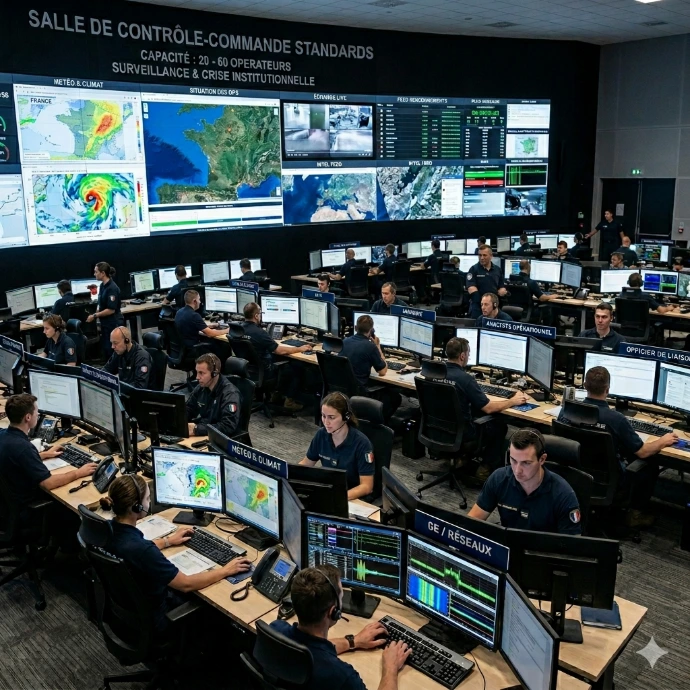
These permanent and highly technological structures oversee the monitoring and management of institutional crises.
- Capacity: 20 to 60 operator positions.
- Profiles: Analysts, weather experts, electronic warfare specialists, and liaison officers.
Cyber Centers
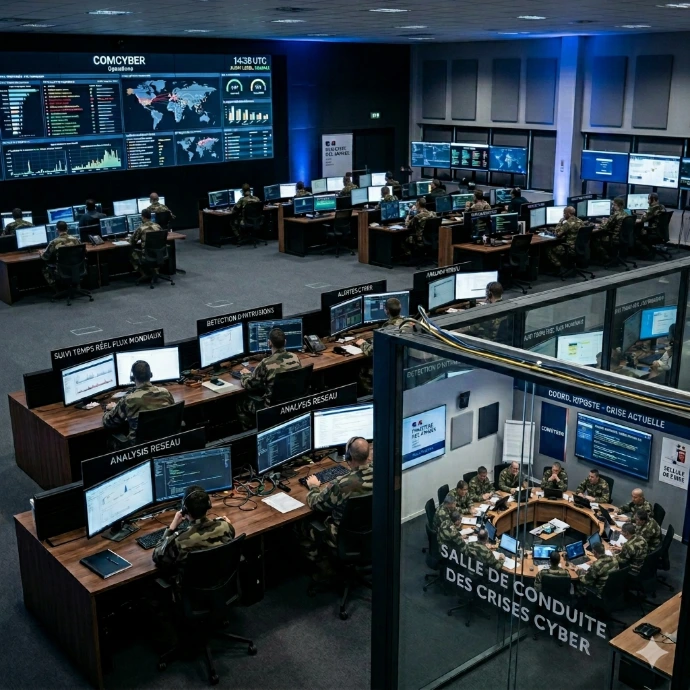
Modeled on the logic of Security Operations Centers (SOC), these platforms manage global digital flows and real-time intrusion detection.
- Capacity: Dozens of positions spread across several platforms. The specific room for managing cyber crises generally brings together a dozen strategic positions to coordinate the response.
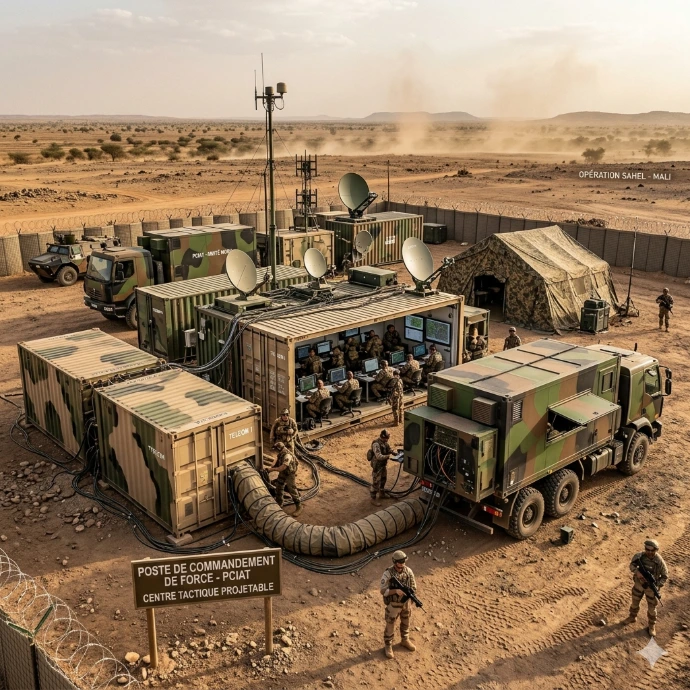
Deployable Tactical Centers (Mobile)
Deployed as close as possible to external operation theaters (e.g., Sahel, Romania), these Force Command Posts (PCIAT) prioritize compactness and mobility.
- Capacity: 8 to 20 operator positions (up to 30 depending on the configuration).
- Format: Containers (shelters) and highly technological truck modules connected to each other, dismountable in less than 2 hours.
Summary of configuration standards
|
Type of Room / Center |
Number of Operator Stations |
Screens per Station |
Main Image Wall |
|
Strategic |
20 to 60 |
3 to 4 |
Yes (Giant Screen) |
|
Tactical / Field |
8 to 20 |
2 to 3 |
Yes (Medium Format / TV) |
|
Cyber |
15 to 40 |
4+ |
Yes (Multi-stream) |
Spatial Arrangement Models
The physical organization depends on the infrastructure:
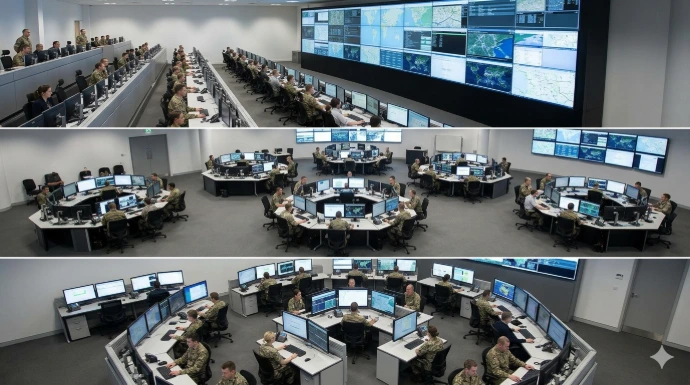
- The "Theater" arrangement (or Successive Rows): The consoles face the central image wall. The highest ranks are positioned in the back rows to maintain an overall view of the analysts and the main screen.
- The "Daisies" arrangement: Grouping of consoles by sectoral islands, promoting direct communication between experts of the same pole.
- The Dense Tactical arrangement: An ultra-compact space where the Operations Chief is placed in the center, allowing him to scan all the screens of his subordinates.